
Reviewed · CITY TOURS
City Tour of Historical Swakopmund
Swakopmund’s story is written in its buildings. This two-hour tour makes the town easier to understand by linking its German colonial architecture to the port, military, trading, and religious life that shaped early Swakopmund. I like the focused route, especially the Woermannhaus and Marine Memorial, and I like that guide Hans-Dieter Göthje brings long family ties to the town into his explanations. The main consideration is that this is a history-first experience, so you should not expect a long list of modern attractions or adventure activities.
I also like the modest $37.16 price, particularly if you want an introduction before exploring on your own. The tour is small enough to have a maximum of 25 people, though that is not an especially tiny group. Pickup is offered, and the outing returns to the starting point at the Swakopmund Museum.
In This Review
- Key things to know before you book
- Why this short Swakopmund tour is worth your time
- Starting at the Swakopmund Museum
- Woermannhaus: Swakopmund’s trading past in timber and plaster
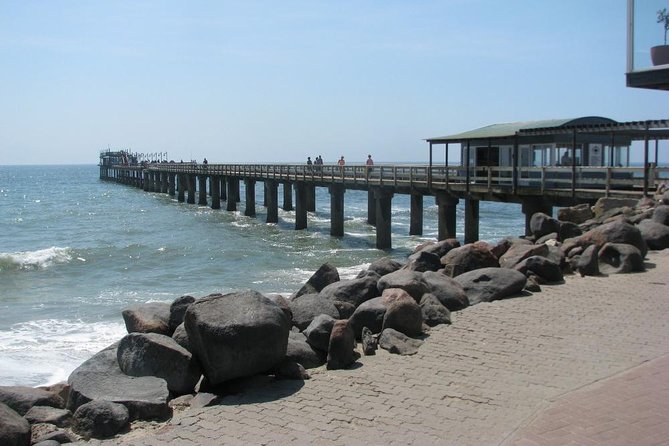
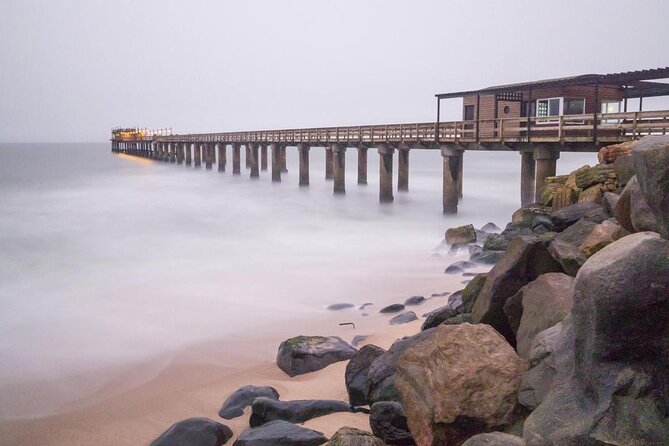
- The Swakopmund Jetty and the difficult Atlantic crossing
- Prinzessin-Rupprecht-Heim and the town’s early social life
- Haus Hohenzollern and the grander side of German architecture
- The Lutheran church and a story about early worship
- The Marine Memorial and the harder side of the town’s past
- Guide quality and the value of local knowledge
- Price, timing, and who gets the most value
- Should you book the City Tour of Historical Swakopmund?
- FAQ
- How long does the City Tour of Historical Swakopmund last?
- Where does the tour begin?
- Where does the tour end?
- Is pickup available?
- How many people can join the tour?
- What sites are included?
- Can I cancel for a full refund?
Key things to know before you book
- Woermannhaus is the architectural highlight: See a 19th-century trading headquarters with a distinctive Fachwerkbau design and the old Damara Tower.
- The jetty explains Swakopmund’s beginnings: The iron structure replaced a wooden jetty and remains one of the town’s most recognizable sights.
- Hans-Dieter Göthje is a major strength: His family connection to Swakopmund and his knowledge of the area add useful local detail.
- The route covers six important sites: Expect the Woermannhaus, jetty, Prinzessin-Rupprecht-Heim, Hohenzollernhaus, Lutheran church, and Marine Memorial.
- It is short but well packed: The scheduled stops add up to about two hours, with visits lasting from 15 to 30 minutes.
- You get historical context, not just photographs: The guide explains why the buildings were made and how they relate to the town’s early development.
Why this short Swakopmund tour is worth your time
Swakopmund can feel unusual at first. Its streets contain German-style buildings, old monuments, and seaside structures that seem far removed from the surrounding Namib Desert. A walk without context can become a quick architecture hunt. This tour gives you the dates, names, and stories that connect the pieces.
The town was founded in August 1892 by the German Colonial Reich. For many years, its main harbour depended on the mole and later the jetty. Both structures remain, although the jetty is the more visible attraction today.
I value the way this tour concentrates on the historical center instead of trying to cover every corner of town. You spend enough time at each site to understand its purpose, then move on before the visit becomes too slow. The scheduled stops are practical for anyone with only part of a day in Swakopmund.
The tour is also useful early in a stay. Several people who enjoyed it used the experience to get their bearings and understand the town before seeing more of it independently. One outing with Hans included both walking and driving around Swakopmund, which was appreciated because it showed more than the central buildings alone. The exact balance may depend on the arrangement for your departure, so ask when booking if seeing areas beyond the center matters to you.
More Swakopmund days:
- Walvis Bay: Marine Big 5 Luxury Catamaran Tour
★ 4.8 · 1,012 reviews - Swakopmund: Desert Dunes Quad Biking with Optional Sandboard
★ 4.9 · 590 reviews - Walvis Bay and Sandwich Harbour Tour
★ 4.8 · 483 reviews
Starting at the Swakopmund Museum
The meeting point is the Swakopmund Museum on Strand Street. This is a sensible place to begin because the tour quickly connects the town’s coastal setting with its built history.
Pickup is offered, and the location is near public transportation. Confirmation is provided at booking. Since the tour ends back at the meeting point, you can plan the rest of your day from the same central area.
Most people can participate, according to the tour details. Still, remember that the experience is described as a walking tour, with several outdoor stops. You should be comfortable moving between sights and spending time outside.
Woermannhaus: Swakopmund’s trading past in timber and plaster
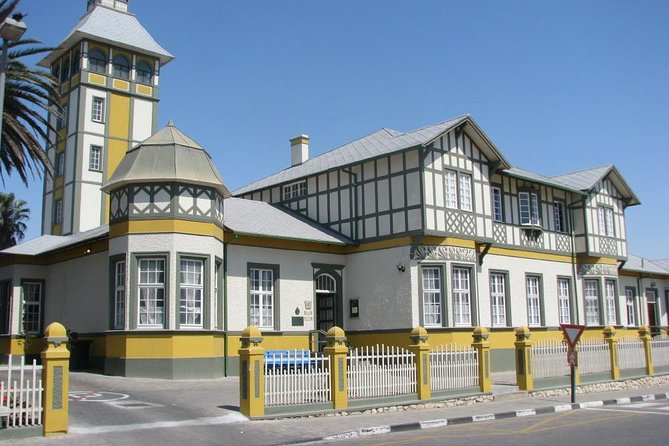
The first major stop is Woermannhaus on Bismarck Street. Built in 1894 by the Damara and Namaqua Trading Company, it is one of the clearest examples of early Swakopmund architecture.
The building was designed in Friedrich Höft’s Fachwerkbau style. That means you will notice the decorative timber framing and the way the structure differs from the plain modern buildings around it. It was later extended in 1903 and 1904, when wood-paneled offices were added.
Woermannhaus served as the headquarters of the leading trading company in what was then South West Africa. The company later became known as Woermann, Brock & Co. In 1909, selected officials and employees also lived there, giving the building both a commercial and residential role.
Allow about 30 minutes here, the longest stop on the route. That is appropriate because there are several details to take in. The courtyard once held an evergreen garden, a small reminder of how residents tried to shape a comfortable setting in an arid place.
Look up toward the northwest corner for the Damara Tower. It served as a lookout, flag mast, and navigation point. That practical mix of business, communication, and port activity helps explain why Woermannhaus mattered beyond its appearance.
This is the stop where a good guide adds the most value. You can see the building yourself, but its role in trade and town development is less obvious without explanation.
The Swakopmund Jetty and the difficult Atlantic crossing
The iron jetty receives about 15 minutes, but it may be the most memorable outdoor stop. It extends into the Atlantic and gives you a direct sense of Swakopmund’s connection to shipping.
The present jetty was built in 1912 to replace an earlier wooden structure that had fallen into poor condition. Two companies from Mannheim, Germany, received the contract, with plans for a 640-meter jetty.
Construction was not simple. Rocky ground created major problems, so the builders had to develop a drilling program to get through it. When the First World War began, work stopped. The finished jetty reached only 262 meters.
That unfinished length is part of its story. Despite the harsh Atlantic conditions, the structure survived more than 70 years with little or no repair. You are not simply looking at an old pier. You are seeing the remains of an ambitious port project that never reached its planned scale.
The 15-minute visit is enough for a historical explanation and a look at the structure. Depending on conditions and the exact route, you may want extra time later for your own photographs. The formal tour keeps moving, so do not count on a long unstructured stay.
Other history-led days in Swakopmund:
- Swakopmund Best Cultural Historical Township Tours Namibia
★ 5.0 · 8 reviews - Explorer Historical Private Township Cultural Tours
★ 4.0 · 6 reviews - Half Day Swakopmund Cultural Historical Township Tour
★ 5.0 · 4 reviews - Cultural Tour in Swakopmund
★ 5.0 · 3 reviews
Prinzessin-Rupprecht-Heim and the town’s early social life
The Prinzessin-Rupprecht-Heim takes about 20 minutes. Its appearance and original use reveal a different side of early Swakopmund.
Built in 1902, it was first a military hospital. The hospital closed in 1909, and the building became a convalescent home in 1911. Two years later, the Bavarian Women’s Association of the Red Cross took it over and funded major renovations with a donation of 35,000 mark.
The name honors Princess Rupprecht, patroness of the Bavarian Association and wife of the heir to the Bavarian throne. You do not need to memorize every title to appreciate the building. The important point is that this was not only a port and trading town. It also needed hospitals, recovery facilities, and organized care for the people living there.
This stop works well after the jetty because the two places show different parts of the same settlement. The jetty points outward to shipping and trade. The former hospital points inward to the daily needs of soldiers, workers, and residents.
The building is now associated with Hotel Prinzessin Rupprecht B&B Swakopmund Namibia. The tour is primarily about its historical role, so expect an exterior-focused explanation rather than a lengthy hotel visit.
Haus Hohenzollern and the grander side of German architecture
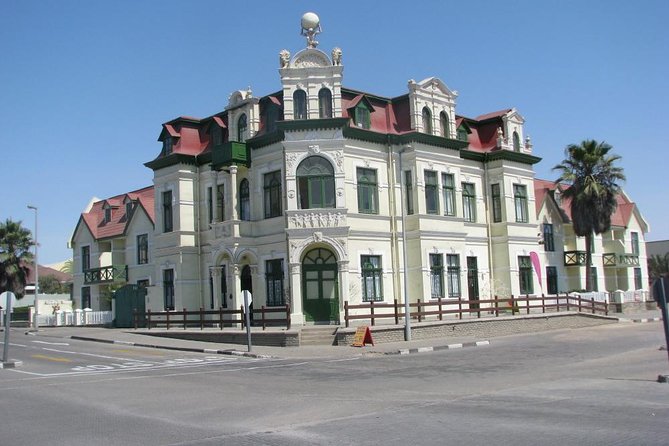
Haus Hohenzollern was built between 1904 and 1906. It began as a hotel and remains one of the more elaborate buildings on the route.
Its decoration is easy to spot. Cupid and flower details adorn the building, while the corner pediment is edged with two lions. At the top, an imperial figure of Atlas carries the world on his shoulders.
The building rises above its neighbors, making it a useful reminder that early Swakopmund had ambitions beyond being a rough port settlement. Its design is ornate and confident, with a level of decoration that may surprise you in a town beside the desert.
You will have about 15 minutes here. That is enough to study the facade and hear why it was built in this style. If ornate architecture is your main interest, this may feel too brief. If you prefer a varied route, the short stop keeps the tour from becoming a parade of similar facades.
The guide’s explanation also helps you see the difference between a commercial headquarters such as Woermannhaus and a hotel designed to project status. Both are old German-style buildings, but they served very different purposes.
The Lutheran church and a story about early worship
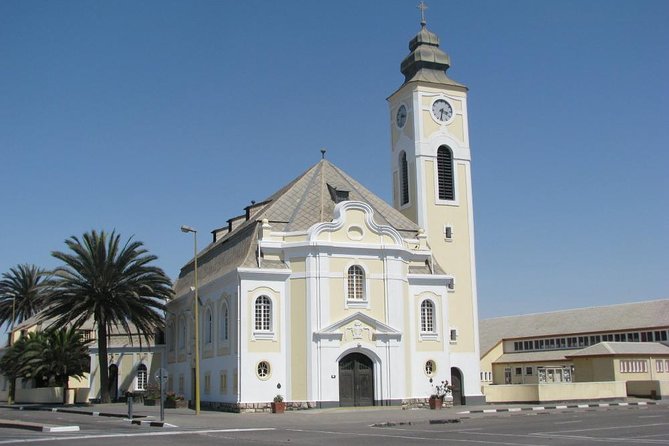
The German Evangelical Lutheran Church is scheduled for 20 minutes, along with its adjacent parsonage. It is one of the route’s strongest examples of a building created for community life rather than business or government.
A local story tells of Pastor Vedder arriving in 1905 for an open-air service and finding nobody there. He supposedly returned to his home, a wooden crate without a roof, doors, or windows, with his sermon still folded and unread.
The congregation later organized plans for a permanent church. Architect Ertl designed a Neo-Baroque building, and F. H. Schmidt received the construction contract in 1910 for 85,000 Mark. Franz Schilling of Apolda, Germany, cast the three bells.
That story gives the church a human scale. It is easy to admire an elaborate facade, but the details about the pastor, congregation, bells, and parsonage show how a settled community gradually took shape.
The stop is especially useful if you want more than military and trading history. It shows the religious and social institutions that supported colonial Swakopmund. The town’s German character is clear here, but the colonial setting also deserves thoughtful attention. Ask Hans how the church and other institutions relate to Swakopmund today if you want the historical account connected to modern life.
The Marine Memorial and the harder side of the town’s past
The final listed stop is the Marine Memorial, or Marine Denkmal. It is dedicated to members of Germany’s First Marine Expedition who were killed in action.
The sculpture shows a standing marine beside a fallen comrade. Berlin sculptor A. M. Wolff designed it, and Gladenbeck A. G. in Berlin cast it. The crew of the gunboat Panther presented the monument to Swakopmund on behalf of the Marine Infantry on July 26, 1908.
The National Monuments Commission declared it a national monument on January 2, 1969. You will spend about 20 minutes here, enough time to examine the detailed figures and hear about the monument’s purpose.
This is an important stop because it complicates the pretty architectural story. Swakopmund’s German colonial appearance is a major reason people visit, but the buildings and monuments also reflect military power and colonial rule. The memorial is not just a decorative statue. It represents loss, conflict, and the political history behind the town’s development.
I would listen closely here and ask questions. A strong guide can help you appreciate the craftsmanship without treating the colonial past as a simple romantic tale.
Guide quality and the value of local knowledge
The guide most closely associated with this experience is Hans-Dieter Göthje. His grandparents migrated from Germany, and he has lived in the area his whole life. That background gives him a personal connection to the town’s German heritage and local development.
His best contribution is not merely naming buildings. He explains how the structures fit into Swakopmund’s early years and how past events affected the town’s current setting. The information is described as clear, detailed, and fascinating, which matters on a short tour with several stops.
Hans has also led outings that combine a walking route with a drive through more of Swakopmund. That can be useful if you want to see areas beyond the historical center. If your priority is the exact six-stop route, confirm how your tour will be conducted.
The maximum group size is 25. That is manageable, but the experience may feel more personal with fewer people. If you want to ask detailed questions about Namibia and South West Africa, try to stay near the guide.
Price, timing, and who gets the most value
At $37.16 per person, this is fairly priced for a guided introduction lasting about two hours. You are paying for interpretation and local knowledge rather than entry tickets, since the listed stops have no admission charge.
The value is strongest if you are new to Swakopmund, interested in architecture, or want a clear starting point before exploring alone. It is also useful if you have limited time and want six major historical sites arranged into one efficient outing.
The value is weaker if you already know the town well or prefer a relaxed, self-guided walk. You will not receive a long museum visit or an adventure activity. The tour is focused, factual, and built around outdoor viewing.
The activity is often booked 36 days ahead on average, so planning early is sensible if your schedule is fixed. Free cancellation is available until 24 hours before the start time. Changes or cancellations inside that window are not accepted for a refund, and the tour requires a minimum number of participants. If that minimum is not reached, you will be offered another date or experience, or a full refund.
Should you book the City Tour of Historical Swakopmund?
Book it if you want a compact, guided introduction to Swakopmund’s architecture and colonial-era development. The route is easy to understand, the price is reasonable, and Hans-Dieter Göthje adds personal local context that a guidebook cannot provide.
I would especially recommend it near the beginning of your stay. Afterward, Woermannhaus, the jetty, and the Marine Memorial will mean more than they would as isolated photo stops.
Skip it if you want wildlife, dunes, food, or a broad modern-city tour. This experience stays firmly with historical buildings and monuments. For the right visitor, that focus is its strength.
FAQ
How long does the City Tour of Historical Swakopmund last?
The tour lasts approximately two hours. The six scheduled stops together account for about 120 minutes.
Where does the tour begin?
The meeting point is the Swakopmund Museum at 8GFF+Q62, Strand Street, Swakopmund, Namibia.
Where does the tour end?
The activity ends back at the Swakopmund Museum meeting point.
Is pickup available?
Yes. Pickup is offered, and the meeting point is near public transportation.
How many people can join the tour?
The maximum group size is 25 people.
What sites are included?
The route includes Woermannhaus, the Swakopmund Jetty, Prinzessin-Rupprecht-Heim, Haus Hohenzollern, the German Evangelical Lutheran Church, and the Marine Memorial.
Can I cancel for a full refund?
Yes. You can cancel at least 24 hours before the experience start time for a full refund. Cancellations or changes made less than 24 hours before the start time are not refunded or accepted.
Written up most recently in Swakopmund
- Walvis Bay Shore Excursion: Flamingos, Dune 7, Swakopmund★ 5.0 · 3 reviews
- 7 Days-Desert adventure, Swakopmund & Etosha Lodging Tour★ 5.0 · 2 reviews
- 06 Days Etosha, Swakopmund and Sossusvlei | Guided Lodge★ 5.0 · 2 reviews
- Seal Kayaking at Pelican Point from Swakopmund★ 5.0 · 8 reviews
- Swakop River Valley & Spitzkoppe Full Day 4×4 tour from Walvis Bay★ 5.0 · 3 reviews
- Walvisbay Dune 7 and Swakopmund Town Half Day Guided Tour★ 4.0 · 4 reviews
- Private Half Day Coast Tour of Walvis Bay and Swakopmund City★ 4.0 · 6 reviews
- Unforgettable Half Day Adventure, Explore Sandwich Harbour★ 5.0 · 3 reviews
City Tours, compared.

Half-Day Windhoek City and Township Cultural Tour
Read our review →

swakopmund city tour dune 7 pink lake pink flamingos
Read our review →

Walvisbay & Coastal Town City Private Local Guided Day Tour for Cruise Ships
Read our review →
Browse the lists this tour appears in